ROOM 9006 (EP): When Sound Became Something I Could Paint
- Richard Insall-Jones
- May 19
- 4 min read
This question has been bugging me for quite some time: how do I combine my love of painting with my love of music?
How could visual art interact with music?
This is hardly a new question, of course, but it’s something I’ve wrestled with for years—and still do.
My painting and music have largely existed as separate creative worlds. It’s only relatively recently that I’ve taken both seriously, encouraged in no small part by Ruth, my partner, who actively pushes me to keep “mucking about” with paints and instruments.
The pressures surrounding artists and musicians today can feel immense. Finding a meaningful route to income through creative work is difficult enough. Add to that an oversaturated landscape, the constant demand for content, social media comparison, and the quiet pressure to compromise your work simply to remain visible.
That pressure is real.
For me, it’s just another challenge I’m willing to take on.
And then there’s AI.
A friend recently played me an album—an entire album—created by a friend of his using AI. The vocals, music and lyrics were all generated using AI. The creator wasn’t a musician. Not even close.
What disturbed me was that the music was good.
Good in the sense that if it appeared in a playlist alongside music created by human musicians, most people probably wouldn’t notice.
And there’s AI in art too. Same story.
The truth is, I don’t hate AI. I actually find it incredibly useful as a tool. For someone largely self-taught like me, it can dramatically speed up learning, research and technical problem-solving. It saves endless hours disappearing down Google and YouTube rabbit holes.
But I have very little interest in outsourcing the actual act of creating.
ROOM 9006 became my way of pushing back against that.

To make things even harder for myself, I decided that the music would be created as manually as possible.
I use Logic Pro to record, mix and produce, but I don’t rely on its vast library of ready-made sounds. For ROOM 9006, I played real instruments. Guitar. Bass guitar. Piano. For percussion, I literally bang on my cajon. For sound design, I used my Moog Prodigy—an analogue synthesiser I’ve owned for more than forty years.
I could explain how I built violin and cello sounds using the Moog, but unless you’re a synth enthusiast, I’ll spare you the details.
What mattered to me was that the sounds were mine.
The conventional approach to writing music is to create structure and largely stick to it. That had always been my default way of working too—often involving many happy (and occasionally stressful) hours refining things note by note.
But I wanted ROOM 9006 to begin differently.
I wanted to remove structure entirely.
So I chose an instrument and simply played.
No rehearsing. No plan. No editing.
The session became very similar to painting.
Choose the colour. Commit to the mark.
Once a note was recorded, it stayed.
There would be no painting over mistakes. No correcting awkward pauses. No removing dissonant notes. Everything remained exactly as it happened in that moment.
That became the discipline.
The session was everything.
There was nothing before it and nothing after it.
I would simply play until the piece reached what felt like a natural conclusion.
And that’s exactly what I did.
Listen to ROOM 9006 EP: Spotify | Apple Music
Once those spontaneous recordings were complete, I allowed structure back into the process.
I layered additional instruments around those raw performances, building frameworks that supported the original sessions without stripping away their imperfections. Interestingly, hidden patterns often emerged from the chaos. Certain sections revealed their own natural structures, and I worked around them.
As the musical project developed, a new question emerged:
Could I somehow express this visually?
During a break from recording, I was doomscrolling on YouTube when I stopped on a video showing a professor demonstrating how vibrations create geometric patterns on thin sheets of metal covered in fine sand.
He dragged a violin bow across the metal plate.
The sand instantly jumped into formation.
Change the vibration and the pattern changed too.
To me, this felt like witnessing music becoming visual art in real time.

I have a rudimentary understanding of coding, and what I was seeing could be recreated mathematically.
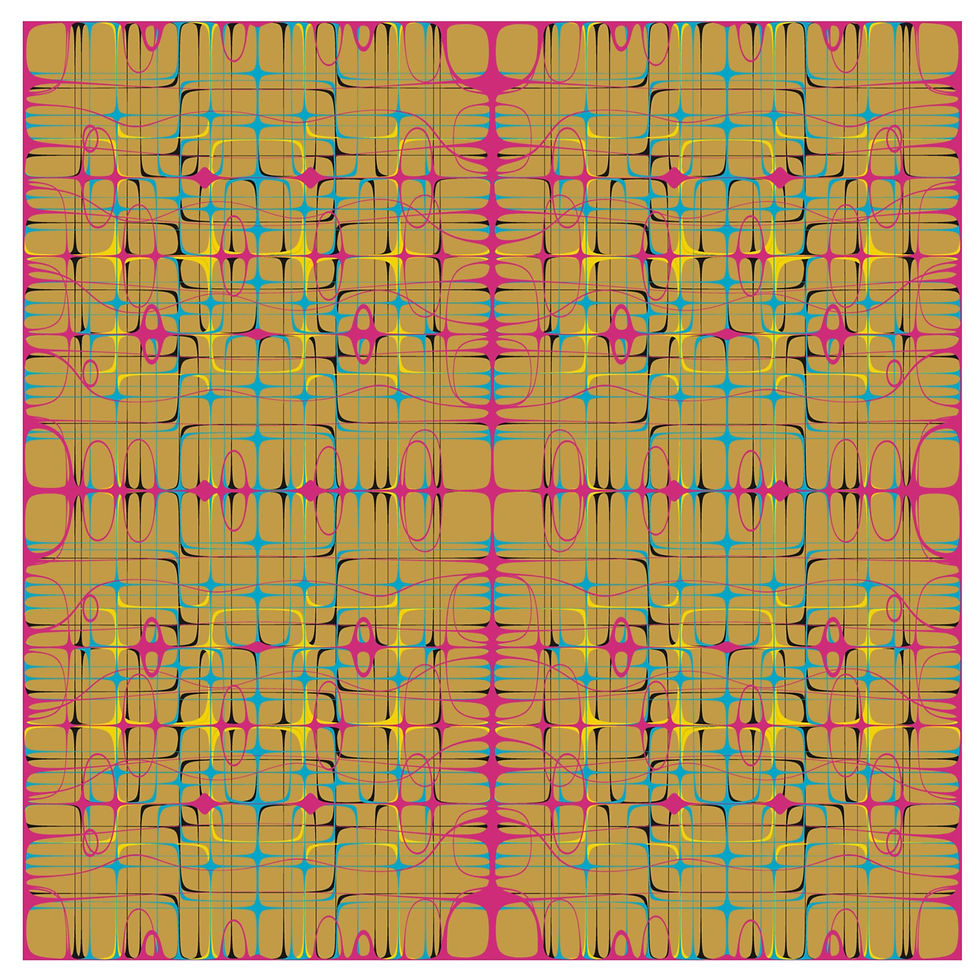
So—with a lot of patience, experimentation and occasional frustration—I built an app that could scan my music and generate unique visual patterns for each track.
Music DNA.
The app was highly specific to what I wanted to achieve, even matching frequencies to the colours I intended to use in the paintings. I saw the software itself as part of the artwork.
The visual outputs were often chaotic, dense and unpredictable.
Perfect.
I interpreted these patterns into acrylic paintings, selecting fragments of the generated compositions that best reflected both the bold structures and disruptive rhythms of the music.

Although the music came first, I never wanted the paintings to feel like merchandise for an album.
And I didn’t want the music to become background material for the paintings either.
Both needed to stand on their own.
ROOM 9006 taught me something I wasn’t expecting.
Even after experimenting with coding, digital systems and mathematical patterns, I found myself returning to the same thing I’ve always loved most: making tangible things by hand.
Playing real instruments.
Painting real canvases.
Creating something imperfect, physical and human.
In a world increasingly fascinated by automation, I’ve found myself becoming more interested in analogue execution.
That, perhaps, is what ROOM 9006 really became:
an experiment in using modern tools to create something unmistakably human.
View ROOM 9006 No. 1


Comments